When you purchase through links on our internet site , we may earn an affiliate commission . Here ’s how it work .
An enormous asteroid has just whizz along safely past Earth , but it is n’t done with our planet yet .
This weekend , the mass - size of it space rock-and-roll will peak in smartness in a rarefied once - in - a - decade event that you could find from base withbasic stargazing binoculars — or in a free livestream .
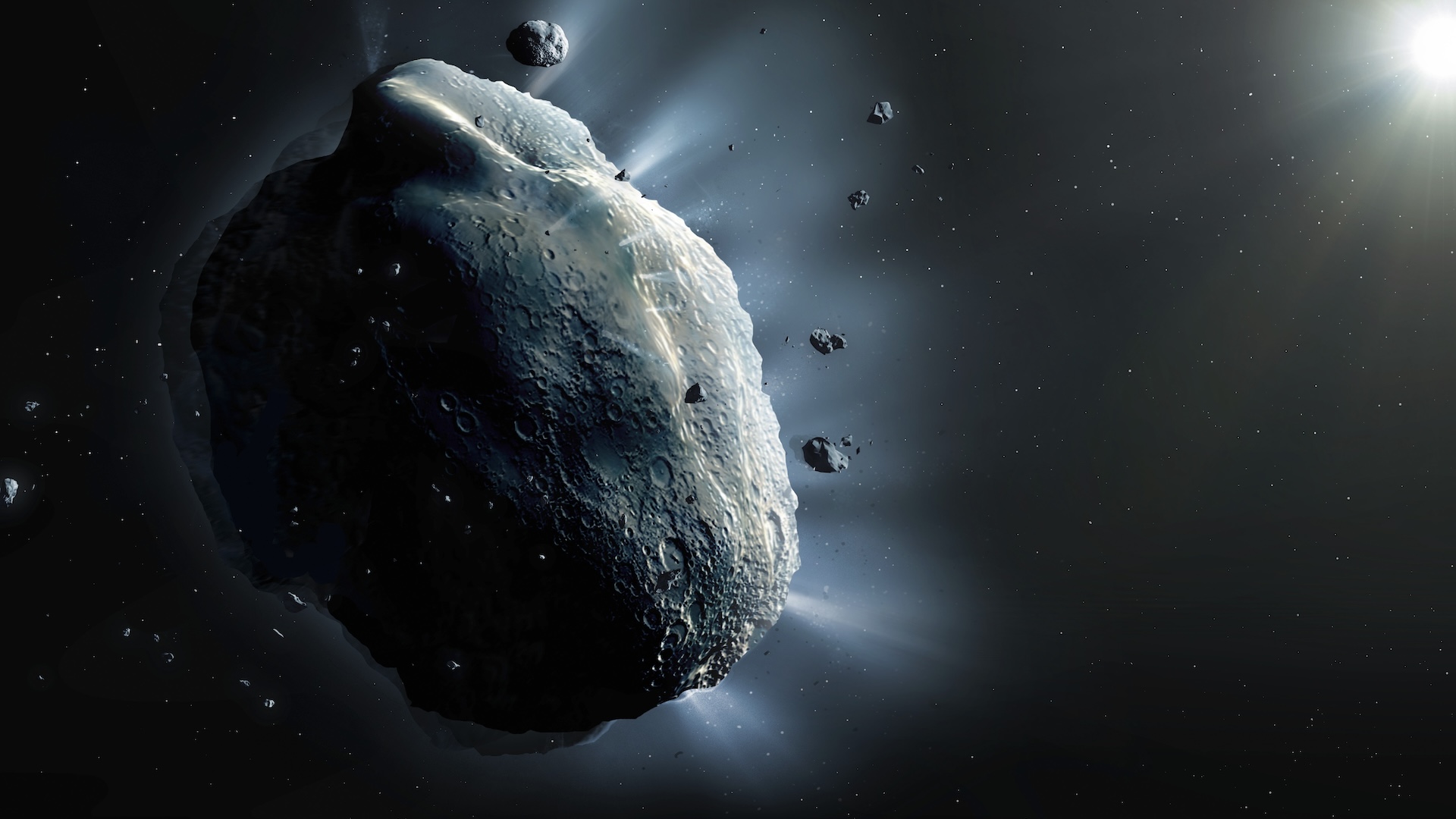
An illustration of a bright, near-Earth asteroid like Alinda
Named ( 887 ) Alinda , the skinny - Earth asteroid measure an estimated 2.6 miles ( 4.2 kilometre ) astray — approximately the breadth of Manhattan — according to NASA ’s Jet Propulsion Laboratory . On Wednesday ( Jan. 8) , the chunky distance rock made its cheeseparing approach to Earth in decades , pounce to within 7.6 million mile ( 12.3 million km ) of our major planet , or about 32 times the averagedistance between Earth and the moon . Alinda is n’t portend to make another close approach to Earth until 2087 .
While an asteroid this bigcould trigger a aggregate experimental extinction eventif it were to clash with Earth , its with child size also produce it a corking target area for peculiar stargazers . On Sunday ( Jan. 12 ) , Alinda will peak in brightness at a magnitude of 9.4 . That is n’t shiny enough to be seen with the naked eye , but it ’s bright enough to be visible through ledger entry - level stargazing binoculars or agood backyard telescope , according to astronomer Gianluca Masi , who runs the Virtual Telescope Project in Italy .
The asteroid will be seeable moving through the constellation Gemini , which appear in the Northern Hemisphere just after night and remains visible all night long , harmonise to skywatching reporterJamie Carter .

relate : NASA ’s most want : The 5 most grievous asteroids to world
If you do n’t have the gear , do n’t fret ; Masi and the Virtual Telescope Project are host a free livestream of asteroid Alinda ’s hopeful flyby on Jan. 12 at 12:30 p.m. EST . you could watch it onthe project ’s official YouTube pageor in the video engraft below .
It ’s uncommon to see such a large object pass this skinny to Earth . According to Masi , upshot like this materialize just once a 10 , and Alinda is one of the five largestasteroidsthat will conk within 9.3 million miles ( 15 million km ) of our satellite from now until the year 2200 .

— ' Spectacular ' asteroid blazes over Siberia just hours after it was detected
— ' Like nothing we ’ve seen before ' : James Webb scope stag a mysterious asteroid - comet hybrid lurking past Jupiter
— James Webb scope spots more than 100 young asteroid between Jupiter and Mars — and some are heading toward Earth

Luckily , neither Alinda nor any other known asteroid poses a threat to Earth for at least the next hundred , consort toNASA . However , space agency take the threat of " planet killer " asteroids very seriously and are presently testing various planetary defense plans . NASA ’s late Double Asteroid Redirection Test ( DART ) mission proved that it is potential to divert a large asteroidby crashing a space vehicle into it . However , the logistics of in reality protecting Earth from a sullen asteroid would likely need firing hundreds of rockets simultaneously , which would involve years to decades of advance observance , Live Science previously reported . In the interim , China be after to launch its ownasteroid deflexion missionby 2030 .
If bright asteroids are not your space jam , then outride tuned for spate of other exciting stargazing opportunities this calendar month . On Monday ( Jan. 13 ) , thefull Wolf Moonwill come up next to Mars and appear togobble up the Red Planetas Mars slips behind the moon for about four hour , before reemerging on the other side . later on , set off Jan. 21,a parade of six planetswill be visible in Earth ’s skies , with Venus , Mars , Jupiter and Saturn all visible to the nude eye after dark and Uranus and Neptune visible with stargazing equipment . The planet will dawdle in the sky through February , with Mercury also joining the planetary procession in other March .


