Joseph Nicéphore Niépce took the first photo ever, “View from the Window at Le Gras,” from his estate in France in 1826 or 1827 using a technique he’d invented called heliography and a camera obscura.
Today , most of us walk around with an incredibly powerful tv camera in our pockets . We do n’t imagine doubly about taking photographs of our world , from our darling to beautiful landscapes to our family unit and friends . We ’ve come up a long way from what the first photo ever taken looked like .
Here it is , the first picture in story :
Public DomainThe first pic ever taken may not wait like much — but it heralded the beginning of a novel engineering that changed the world .
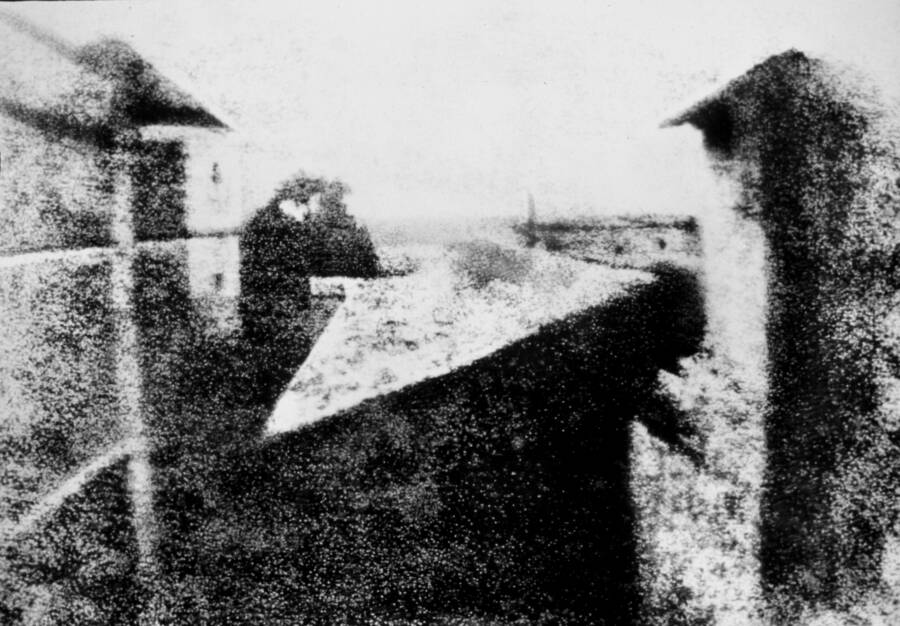
Public DomainThe first photo ever taken may not look like much — but it heralded the beginning of a new technology that changed the world.
This image looks like a wood coal sketch or perhaps some sort of unusual Rorschach trial run . But it ’s actually something much more consequential : a first , tentative step forward in the field of photography .
capture by Frenchman Joseph Nicéphore Niépce in 1826 or 1827 , the so - call “ View from the Window at Le Gras ” check off the beginning of photography as we sleep with it . However , it claim Niépce significant experimentation to produce the first photograph ever taken , and the applied science would swiftly grow after his last in 1833 .
Joseph Nicéphore Niépce, A Photography Pioneer
Public DomainFrench inventor Joseph Nicéphore Niépce .
Born on March 7 , 1765 , Joseph Nicéphore Niépce spend much of his grownup lifetime experiment with new engineering .
His first major invention was an internal - combustion engine , which Niépce built with his brother in 1807 and called apyréolophore(its name issue forth from the Greek words for “ fire , ” “ wind , ” and “ I farm ” ) . But as their 10 - year letters patent on the locomotive engine start to run out , Niépce dislodge his focus .
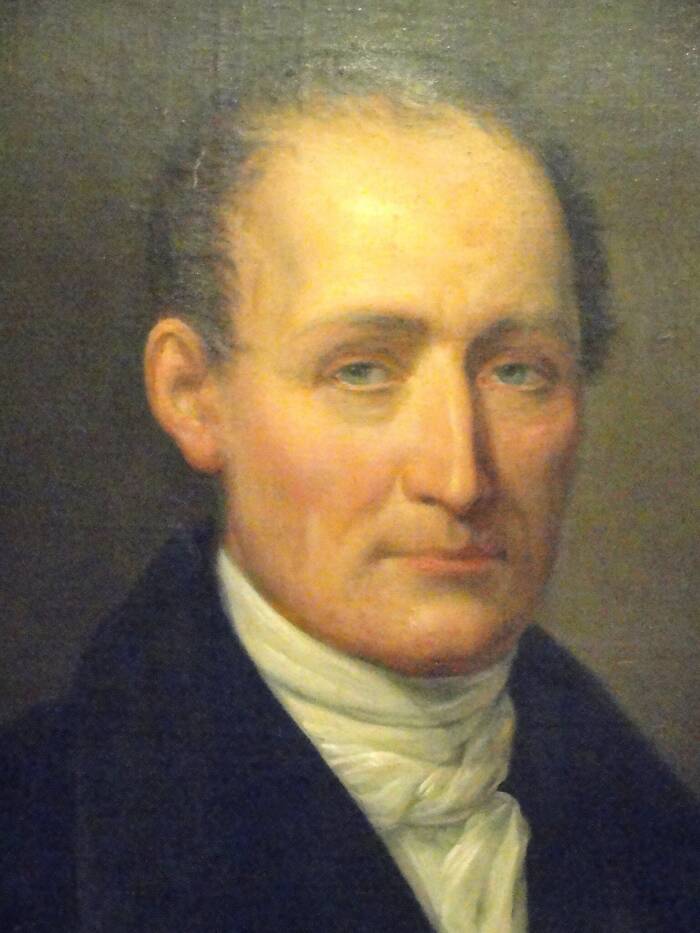
Public DomainFrench inventor Joseph Nicéphore Niépce.
part in 1816 , Niépce start to tinker with what he calledhéliographieor “ sun writing . ” Through trial and error , Niépce was able to produce images on paper coat with silver chloride , but the images were overthrow ( negatives ) , and they darkened entirely when exposed to sunlight .
The failure was frustrative , but Niépce pressed on . A decade later , his experimentation with various chemicals , stuff , and techniques lead him to prepare the first pic ever take .
The First Photo Ever Taken: “View From The Window At Le Gras”
In 1826 or 1827 , Niépce bring home the bacon in producing the first photograph ever taken . As theHarry Ransom Centerreports , he “ dissolved light - sore bitumen in crude of lavender ” then utilize a coating of the mixture over a pewter plate .
Next , Niépce slid the plate into a camera obscura . This engineering science had existed in one form or another for centuries — it was describe as long ago as the fourth 100 B.C.E. — and is fundamentally a dreary space with a minor cakehole . As visible light rain cats and dogs through the fix , it projects a reverse range of a function of the shot outside on the interior rampart .
Public DomainAn 18th - century illustration showing how a camera obscura works .
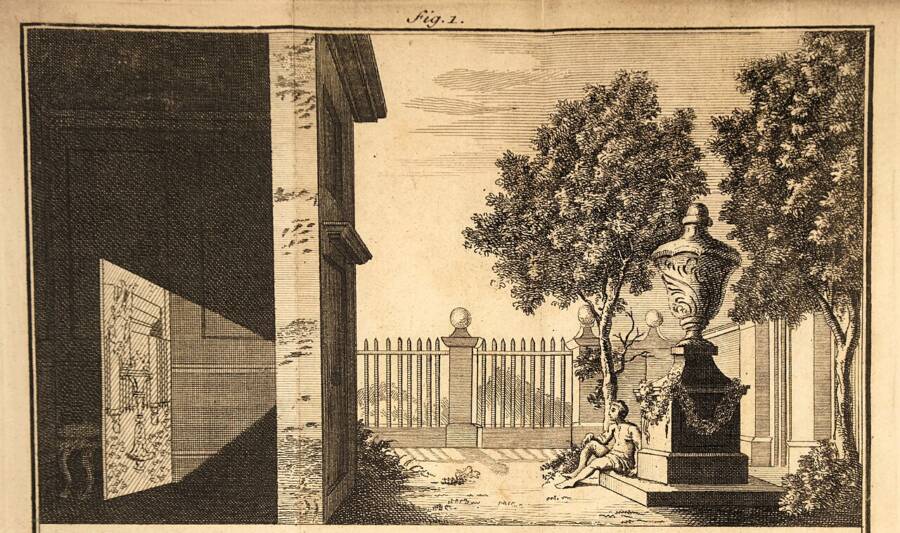
Public DomainAn 18th-century illustration showing how a camera obscura works.
As betimes as 1816 , Niépce had mused on the potentials of the camera obscura , write to his brother that it could be used as “ a sort of unreal eye , simply a little box , each side six inches square ; which will be fitted with a tube that can be lengthened and carry a lenticular glass . ”
A decade later , he harnessed the technology to produce his pic . With the pewter plate in station , he moved the camera obscura near a second - account windowpane at his home in Saint - Loup - de - Varennes , France . Then , he waited . And wait some more . The first exposure in historycertainly did n’t bring out itself chop-chop .
Eight hours subsequently , Niépce found that his experiment had make for . After a long pic to sunlight , the dental plate give an impression of the courtyard , outbuilding , and tree outside . It did n’t look like much , but “ View from the Window at Le Gras ” ( named for Niépce ’s estate ) was a remarkable affair . It was the first photo ever choose .
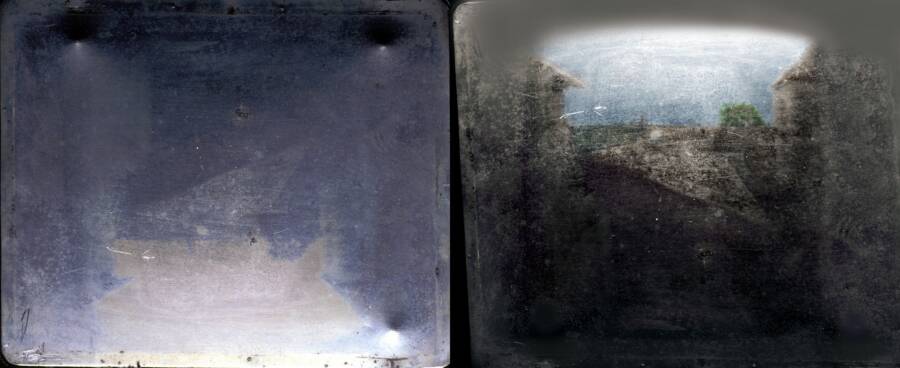
Jonnychiwa/Wikimedia CommonsNiépce’s original plate on the left and a color enhanced version on the right.
Jonnychiwa / Wikimedia CommonsNiépce ’s original plate on the left and a colour raise version on the rightfulness .
As the Harry Ransom Center report , Niépce get laid that his experimentation was just the beginning of an exciting novel engineering science . In December 1827 , he called it “ the first uncertain step in a completely unexampled direction . ” Still , many credit Niépce withinventing the camerabecause of how he utilized a camera obscura to make his historic image in Saint - Loup - de - Varennes .
And after he study his exposure , the field of picture taking began to grow .
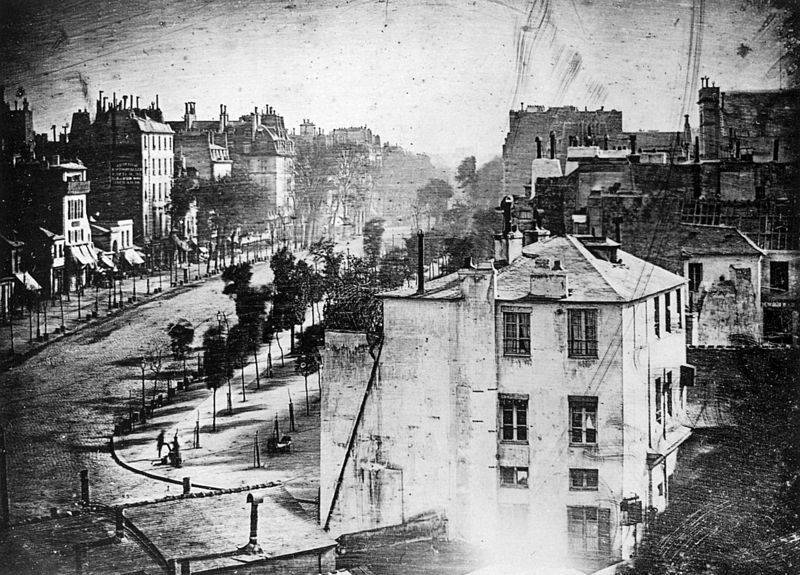
Public DomainThis photo, taken by Louis Daguerre in 1838, is the first to show a human being (on the left side of the frame).
The Growth Of Photography After Niépce’s First Picture
Thehistory of photography , by most accounts , begin with Niépce and “ survey from the Window at Le Gras , ” the first photograph ever . But the technology would soon expand far beyond Niépce ’s blurry pewter denture .
In 1829 , Niépce part working with Louis - Jacques - Mandé Daguerre , a fellow picture taking trailblazer . Though Niépce died just a few old age afterward , in 1833 , Daguerre went on to make thedaguerreotype . This technique build upon Niépce ’s by using highly meditative sheets of Ag - plated metal , treating the sheet with fumes , and exposing them to light .
It allowed Daguerre to enamour thefirst picture with a human guinea pig , and the daguerreotype was used to take pictures until the 1860s . At that spot , it was made obsolete by new picture taking engineering .
Public DomainThis photo , taken by Louis Daguerre in 1838 , is the first to show a human being ( on the left over side of the frame ) .
During the 19th century , the field of picture taking reached vibrant newfangled height ascolor photographywas slowly perfected . And by the end of the nineteenth one C , improvement had been made inmovie - making technologyas well .
Before long , technology existed that could capture epitome unlike anything anyone had ever suppose before . the great unwashed no longer sat for portrait but for picture taking session . Sights and sounds from around the domain were no longer described only in Book but also in picture show and vivid images .
Today , we take for granted how promiscuous photography is . It takes next to no thought at all to pick up our phones and take a photograph — or even a video — which we can instantaneously share with ally , family , and strangers online .
But in Niépce ’s Clarence Day , when he captured the first photo ever taken , such technology would have seemed unsufferable . The Gallic inventor had to labor over unlike chemicals and techniques for closemouthed to a decade before he follow . Even then , his blurry simulacrum acquire a full twenty-four hour period to produce .
His “ sight from the Window at Le Gras ” might not look like much today . But as the first photo ever taken , it represent an exciting step in picture taking whose effects resile to this twenty-four hours .
After visualise the first photograph ever take , check out our gallery ofinfluential photographs that changed the world . Then , look through these stunningcolor photographs from around the worldat the sunrise of the 20th C , financed by Gallic banker Albert Kahn .
